
10 Signs Your Child May Benefit From a Myofunctional Evaluation

Oral function affects more than many people realize.
The muscles of the mouth and face play an important role in breathing, chewing, swallowing, speech, sleep, and oral development.
Sometimes children develop compensatory patterns when one area isn't functioning as efficiently as it could. That doesn't mean they're being difficult or lazy. It may simply mean their body has found a different way to manage a task.
So what might parents notice?
Here are 10 signs that may be worth discussing with a professional.
1. Mouth Breathing
Does your child frequently breathe through their mouth during the day or sleep with their mouth open?
Over time, mouth breathing can affect sleep quality, oral development, and how the muscles of the face and mouth function.
2. Restless Sleep or Snoring
Noisy breathing, frequent waking, teeth grinding, or poor-quality sleep may be signs that your child's airway is working harder during rest.
Sleep quality can affect attention, regulation, growth, and overall functioning.
3. Open-Mouth Posture
Take a look at how your child's mouth rests when they're not talking or eating.
Are their lips frequently apart rather than comfortably closed?
An open-mouth resting posture can sometimes reflect differences in breathing or oral muscle patterns.
4. Low Tongue Posture
Where does your child's tongue rest when their mouth is relaxed?
A tongue that rests low in the mouth rather than against the palate may be worth paying attention to.
Tongue posture plays an important role in breathing, swallowing, oral development, and jaw growth.
5. Tongue Thrust
Tongue thrust is a swallowing pattern in which the tongue presses against or moves between the teeth.
Some children also place their tongue between their teeth when producing certain speech sounds.
These patterns may occur alongside speech sound differences or dental alignment concerns.
6. Persistent Speech Distortions
Does your child continue to have difficulty with certain sounds, such as:
• /s/
• /z/
• /sh/
• /ch/
• /r/
Oral muscle coordination and tongue placement can sometimes contribute to these speech patterns.
7. Messy or Inefficient Chewing
Mealtimes can offer clues about how your child manages food.
You may notice:
• Frequent open-mouth chewing
• Food spilling from the mouth
• Tiring during meals
• Taking a long time to chew or finish a meal
These patterns may reflect difficulties with chewing coordination or comfortable breathing during eating. A feeding evaluation can help identify the cause.
8. Difficulty Managing Textures
Does your child gag, refuse certain foods, pocket food in their cheeks, or avoid specific textures?
These patterns may be connected to oral awareness, coordination, or sensory processing differences.
9. Crowded Teeth or a Narrow Palate
Tongue and lip resting posture, along with breathing patterns, may influence dental and facial development over time.
Genetics and other growth factors also play a role.
If your child’s dentist or orthodontist has mentioned concerns about crowding or palate development, it may also be helpful to discuss breathing patterns, tongue resting posture, and oral function.
10. Prolonged Oral Habits
Thumb sucking and pacifier use are common in infancy and early childhood.
When these habits persist, they may affect tooth alignment and bite development.
Other habits, such as nail biting or chewing on objects, may warrant attention if they cause pain, injury, or interfere with daily activities.
Why Do These Signs Matter?
Breathing, oral resting posture, feeding, sleep, and speech can influence one another.
Noticing one of these signs doesn’t automatically mean your child needs therapy.
Think of them as clues worth discussing with your child’s healthcare providers, especially if they persist or affect daily life.

How Can Myofunctional Therapy Help?
Myofunctional therapy may help support:
• Oral resting posture
• Tongue coordination
• Chewing and swallowing patterns
• Nasal breathing habits
• Speech clarity
• Oral awareness
• Functional oral patterns
At Inside Out Speech & Language Therapy, we look at the child as a whole and consider how breathing, feeding, oral function, communication, and regulation may be connected.
Not Sure If Your Child Would Benefit From an Evaluation?
You don't have to figure it out alone.
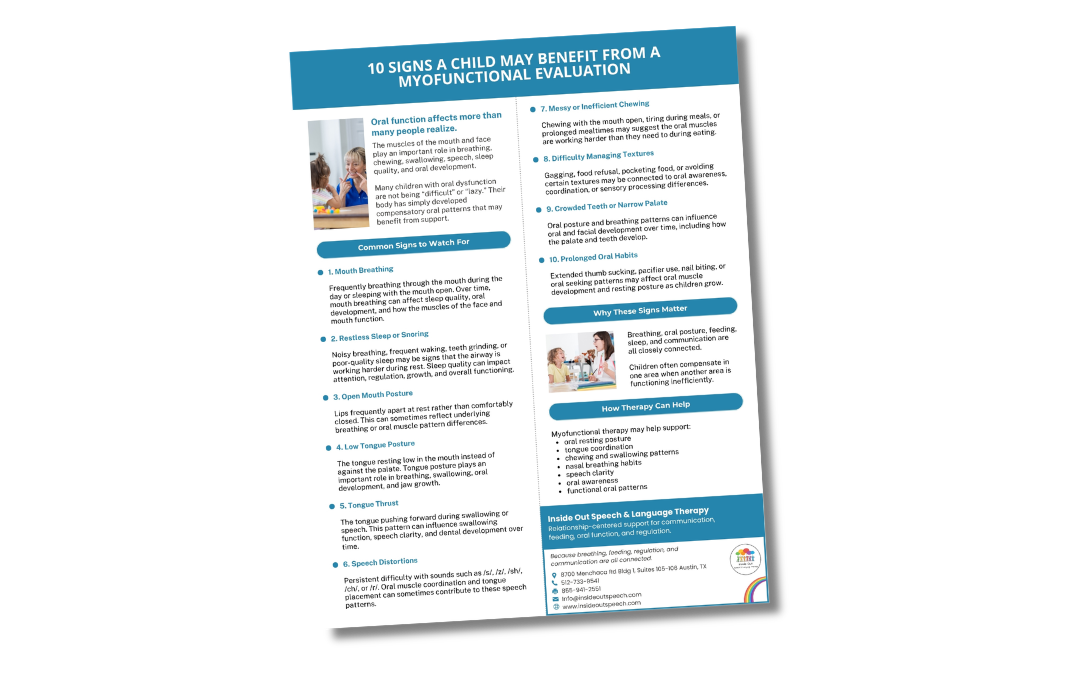
We've created a simple guide covering 10 signs a child may benefit from a myofunctional evaluation.
Download the Free Guide
Inside the handout, you'll find:
• The 10 signs to watch for
• Simple explanations of each sign
• Why these patterns may matter
• An overview of how myofunctional therapy may help
Have Questions About Your Child?
If you've noticed several of these patterns, or if your child's pediatrician, ENT, sleep specialist, dentist, or orthodontist has raised a concern, an evaluation can help you better understand what's happening.
At Inside Out Speech & Language Therapy, we provide relationship-centered support for communication, feeding, oral function, and regulation.
Inside Out Speech & Language Therapy
8700 Menchaca Rd Bldg 1, Suites 105–106
Austin, TX
512-733-9541
Info@insideoutspeech.com
www.insideoutspeech.com
Because breathing, feeding, regulation, and communication are all connected.
